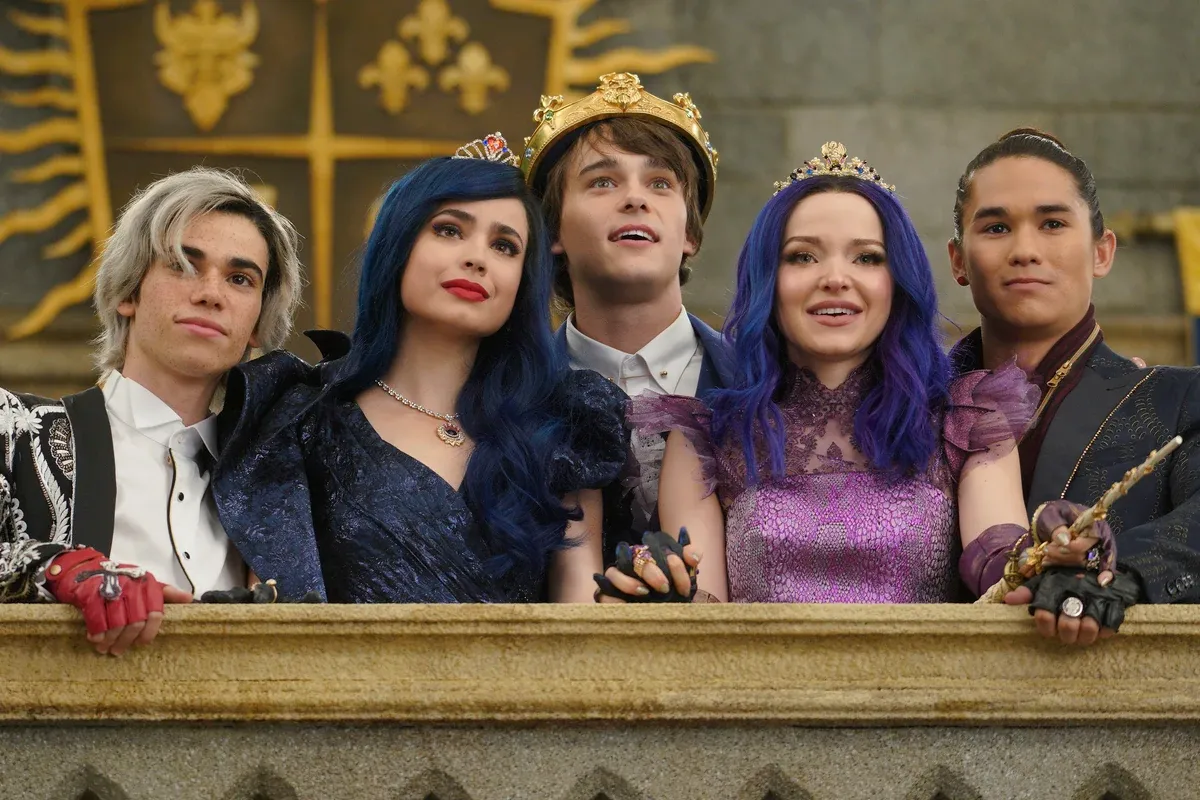
This article undertakes a philosophical examination of the Disney Descendants trilogy, focusing on three pivotal musical numbers: "Set It Off" (Descendants 1), "You and Me" (Descendants 2), and "Break This Down" (Descendants 3). It argues that these songs serve as crucial hermeneutic moments, articulating a progressive teleological trajectory from an initial state of radical alterity to a fully realized cosmopolitan society. This transformation is shown to be mediated through the dynamic processes of hybridity, the Gadamerian fusion of horizons, and the emergence and expansion of Homi K. Bhabha's concept of the third space. By applying these robust philosophical frameworks to a popular cultural phenomenon, this analysis aims to illuminate the complex interplay of identity formation, community building, and the overcoming of societal divisions, thereby demonstrating the surprising philosophical depth embedded within the narrative arc of the Descendants universe. The study concludes by reflecting on the broader implications of such popular cultural texts for contemporary discussions on inclusion, diversity, and global citizenship.
The Disney Descendants trilogy, a series of musical fantasy films, presents a seemingly straightforward narrative of the children of iconic Disney villains navigating life in the idyllic kingdom of Auradon. However, beneath its vibrant surface and catchy tunes lies a surprisingly rich ground for philosophical inquiry, particularly concerning the dynamics of identity, community, and the reconciliation of difference. The central conflict of the trilogy—the integration of the Villain Kids (VKs) from the isolated Isle of the Lost into the established society of Auradon—serves as a compelling allegory for broader socio-political and existential questions. This article posits that the trilogy's musical numbers are not mere entertainment but function as key hermeneutic moments, articulating a profound philosophical journey. Specifically, we will analyze three pivotal songs—"Set It Off" from Descendants 1, "You and Me" from Descendants 2, and "Break This Down" from Descendants 3—to demonstrate a teleological progression from an initial state of radical alterity to a fully realized cosmopolitan society. This transformative process, we contend, is intricately mediated through the philosophical concepts of hybridity, the fusion of horizons, and the creation and expansion of a third space.
Our analysis will proceed by first establishing a rigorous theoretical framework, meticulously defining and exploring the philosophical underpinnings of alterity, the fusion of horizons, hybridity, the third space, and cosmopolitanism. Subsequently, we will undertake a detailed lyrical and contextual analysis of each song, demonstrating how these musical texts embody and advance the aforementioned philosophical concepts. Finally, we will synthesize these analyses to discuss the broader philosophical implications of the Descendants trilogy, reflecting on its contribution to contemporary discourses on inclusion, diversity, and global citizenship. This interdisciplinary approach, bridging popular culture and rigorous philosophical thought, seeks to uncover the latent philosophical insights within widely consumed media, thereby enriching our understanding of both the texts themselves and the complex human condition they reflect.
To adequately explore the philosophical dimensions of the Descendants trilogy, it is imperative to establish a robust theoretical foundation. This section will delineate the core concepts that will serve as our analytical lenses, drawing upon key thinkers in philosophy, hermeneutics, and postcolonial theory. Each concept—alterity, fusion of horizons, hybridity, third space, and cosmopolitanism—represents a distinct yet interconnected facet of the complex process of encountering, understanding, and integrating difference.
Alterity, derived from the Latin alteritas, signifies the state of being 'other' or radically different. It is a concept that has profound implications across various philosophical traditions, particularly in phenomenology and ethics. At its most fundamental, alterity refers to the irreducible distinctiveness of the Other, that which lies beyond the grasp of the self's comprehension or assimilation. Emmanuel Levinas, a seminal figure in 20th-century philosophy, places the concept of the Other at the very heart of his ethical philosophy. For Levinas, the Other is not merely a different self, but an absolute exteriority, a transcendence that resists totalization by the knowing subject [1]. The encounter with the Other, particularly through the 'face' of the Other, imposes an ethical demand, a responsibility that precedes any ontological understanding. This ethical relation is asymmetrical; the Other's vulnerability and absolute difference call the self into question, disrupting its self-sufficiency and demanding a response.
In the context of postcolonial theory, alterity takes on a critical socio-political dimension. Here, the 'Other' is often constructed through processes of colonization and power dynamics, where dominant cultures define and marginalize subaltern groups by emphasizing their perceived difference [2]. This construction of alterity serves to justify oppression, exploitation, and the imposition of a hegemonic worldview. The 'othering' process reduces complex identities to simplified, often negative, stereotypes, thereby denying their full humanity and agency. Postcolonial thinkers, such as Edward Said, have meticulously deconstructed these mechanisms of alterity, revealing how the 'Orient' was constructed as the exotic, irrational 'Other' to the rational, civilized 'Occident' [3]. Understanding alterity, therefore, requires not only an ethical recognition of irreducible difference but also a critical awareness of the power structures that produce and maintain such distinctions. In the Descendants narrative, the inhabitants of the Isle of the Lost are initially presented as the radical Other to Auradon, embodying a perceived threat and a fundamental difference that must be contained.
The concept of the "fusion of horizons" (Horizontverschmelzung) is central to the philosophical hermeneutics of Hans-Georg Gadamer. In his magnum opus, Truth and Method, Gadamer argues that understanding is not a mere reproduction of an author's original intention or a text's objective meaning, but rather a dynamic, dialogical process [4]. Every interpreter approaches a text (or, by extension, another culture or individual) with their own pre-understandings, prejudices (in Gadamer's non-pejorative sense), and historical situatedness—what Gadamer calls their 'horizon.' This horizon is the limit of one's vision, encompassing everything that can be seen from a particular standpoint. However, horizons are not static; they are open and constantly shifting.
Understanding occurs when the interpreter's horizon encounters and engages with the horizon of the text or the Other. This encounter is not a simple merging where one horizon dissolves into the other, but a dialectical process where both horizons are expanded and transformed. The fusion of horizons, therefore, is the emergence of a new, shared understanding that transcends both original perspectives, creating a broader and more comprehensive interpretive space. It involves a willingness to expose one's own prejudices to the challenge of the Other's perspective, leading to a critical self-reflection and a more nuanced comprehension. This process is inherently dialogical, requiring an openness to the unfamiliar and a recognition that truth is not a fixed entity but emerges through ongoing interpretation and conversation. In the context of the Descendants, the fusion of horizons describes the gradual process by which the worldviews of Auradon and the Isle begin to interpenetrate and transform each other, leading to a more inclusive societal understanding.
Homi K. Bhabha, a prominent postcolonial theorist, introduces the concepts of hybridity and the third space as crucial tools for understanding cultural encounters, particularly in colonial and postcolonial contexts. Bhabha challenges simplistic notions of cultural purity and binary oppositions (colonizer/colonized, self/other) by arguing that cultural interaction inevitably produces something new, something that is neither one nor the other, but a hybrid [5]. Hybridity, in Bhabha's formulation, is not merely a mixing of cultures but a dynamic process of negotiation and translation that occurs in the "interstitial space" or "third space" of enunciation. This third space is a liminal, in-between realm where cultural meanings are contested, re-articulated, and transformed. It is a site of ambivalence, where dominant discourses are mimicked, subverted, and re-appropriated, leading to the emergence of new forms of identity and agency.
The third space is thus a profoundly productive site. It is where the authority of existing cultural hierarchies is challenged, and where new, unforeseen possibilities for identity and community emerge. It is a space of rupture and innovation, where the very act of cultural translation creates something that is neither original nor entirely new, but a complex, hybridized entity. For Bhabha, this interstitial space is crucial for resistance and the formation of counter-hegemonic narratives. It is where the subaltern can articulate their voice and where new forms of cultural identity, unconstrained by the binaries of colonial power, can take shape. In the Descendants narrative, the interactions between the VKs and Auradonians, and the cultural products that emerge from these interactions, exemplify the dynamics of hybridity and the transformative potential of the third space.
Cosmopolitanism, literally meaning "citizen of the world" (from Greek kosmopolitēs), is a philosophical and ethical stance that posits all human beings, regardless of their national, ethnic, or cultural affiliations, are members of a single, shared community. Its origins can be traced back to the Cynic philosopher Diogenes, who famously declared himself a "citizen of the cosmos." This idea was further developed by the Stoics, who emphasized universal reason and a shared human nature as the basis for a global moral community [6].
In contemporary political philosophy, cosmopolitanism has evolved into a multifaceted concept, often distinguished into moral, political, and cultural dimensions. Moral cosmopolitanism asserts that all individuals have equal moral worth and that our ethical obligations extend universally to all human beings, not just to those within our immediate community or nation-state. Political cosmopolitanism advocates for global institutions or governance structures that would protect universal human rights and promote global justice. Cultural cosmopolitanism, on the other hand, celebrates the diversity of human cultures and encourages an openness to, and appreciation of, different ways of life, often seeing cultural exchange and hybridity as enriching [7].
While there are debates regarding the feasibility and implications of a truly cosmopolitan world, the core ideal remains a commitment to universal human dignity, global solidarity, and the recognition of shared responsibilities across borders. It challenges narrow nationalism and ethnocentrism, advocating for a broader sense of belonging and interconnectedness. In the Descendants trilogy, the journey towards cosmopolitanism is evident in the increasing acceptance of diversity, the dismantling of exclusionary barriers, and the eventual vision of a unified society where all individuals are valued for who they are, irrespective of their origins.
Having established our philosophical toolkit, we now turn to the musical texts themselves, employing a lyrical hermeneutics to uncover how the Descendants songs articulate and advance the concepts of alterity, fusion of horizons, hybridity, third space, and cosmopolitanism. Each song, strategically placed within the narrative arc of the trilogy, marks a significant stage in the journey from division to unity.
"Set It Off": The Initial Encounter and the Emergence of a Third Space
"Set It Off," the climactic musical number of the first Descendants film, is performed in the celebratory aftermath of Prince Ben’s coronation. This song is not merely a celebratory anthem; it is a profound performative utterance that inaugurates the complex process of integration between the long-separated worlds of Auradon and the Isle of the Lost. Its lyrics and visual context provide the initial philosophical encounter with alterity and the nascent formation of a third space.
From the outset, the Villain Kids (VKs)—Mal, Evie, Jay, and Carlos—represent the radical Other to Auradon’s established order. Their very existence on the Isle, a place of banishment and neglect, signifies a deliberate act of othering by the Auradonian society, a spatial and social demarcation of difference. The lyrics sung by Jay and Carlos, “They all told me I should back down / Judgin’ me ‘cause of my background,” directly articulate the lived experience of this alterity. This is not merely a social stigma but a profound existential condition imposed by their lineage and geographical origin. They are judged not for their actions, but for their inherited identity, a form of pre-judgment that Gadamer would recognize as a deeply ingrained prejudice within the Auradonian horizon. This prejudice constructs the VKs as an irreducible exteriority, a threat to the established order, echoing Levinas’s concept of the Other as that which resists totalization by the self [1].
However, the song simultaneously marks a crucial turning point where this alterity begins to be re-evaluated. The defiant energy of “Set It Off” transforms the burden of ‘otherness’ into a source of empowerment. Mal’s line, “Break the spell, we were born this way / Be yourself, forget the DNA,” is a powerful philosophical statement. It challenges the deterministic notion of identity based solely on genetic or ancestral inheritance, asserting instead a radical freedom to self-define. This is an act of resistance against the imposed alterity, a declaration that their essence is not reducible to their villainous parentage. This embrace of self, despite and because of their unique background, is the first step towards a re-negotiation of their position within the broader societal fabric.
The performance of “Set It Off” itself functions as the nascent emergence of a third space. The post-coronation party is a liminal zone, neither purely the traditional, hierarchical space of Auradon nor the chaotic, marginalized space of the Isle. It is an interstitial realm where the rigid social boundaries begin to blur. In this space, Auradonian students and VKs engage in a shared activity—dancing and singing—that transcends their previous distinctions. This communal performance creates a temporary, yet significant, site of cultural negotiation. It is here that the initial seeds of hybridity are sown, not as a fully formed identity, but as a willingness to engage with and be influenced by the ‘other.’ The very act of collective celebration, a shared rhythm and purpose, begins to dismantle the psychological and social barriers that maintained alterity. This third space, though fragile, offers a glimpse of a future where new meanings and identities can emerge from the interaction of previously separate cultural horizons [5].
Furthermore, “Set It Off” initiates the process of the fusion of horizons. The song’s lyrics, particularly Ben’s call to “Kings and Queens, it’s our time to rise / Write the book story of our lives,” propose a shared narrative and a common future that necessitates the blending of their distinct worldviews. The Auradonian horizon, previously limited by its insular idealism, is now confronted with the lived experiences and perspectives of the Isle. Conversely, the VKs’ horizon, shaped by cynicism and self-preservation, is exposed to the possibility of trust and collective endeavor. While a complete fusion is far from achieved, the song’s dialogical structure and shared aspirations represent a preliminary opening of these horizons, a willingness to engage in the hermeneutical process of understanding that Gadamer describes. It is a recognition that a richer, more comprehensive understanding of their collective reality can only emerge through the mutual engagement and transformation of their individual horizons [4]. The song, therefore, is not just a narrative event but a philosophical catalyst, setting in motion the complex dynamics of identity, community, and understanding that will unfold throughout the trilogy.
"You and Me": The Internalization of Hybridity and the Deepening of Horizons
"You and Me," the poignant closing song of Descendants 2, marks a significant shift in the philosophical trajectory of the trilogy. While "Set It Off" initiated the external encounter with alterity and the nascent formation of a third space, "You and Me" delves into the internalization of hybridity, particularly through Mal’s personal struggle, and the deepening of the fusion of horizons from a societal to a profoundly interpersonal level. This song is a hermeneutic key to understanding the complexities of identity formation when confronted with the demands of integration.
Mal’s journey in Descendants 2 is a powerful exploration of alterity, not as an external imposition, but as an internal conflict. Despite her efforts to assimilate into Auradon, to shed her ‘villain’ past and embrace her role as Prince Ben’s consort, she grapples with a persistent sense of inauthenticity. The lyrics, “When you take a look inside yourself / Do you wish that you were something else? / But who you are is who you need to be,” articulate a profound existential dilemma. Mal’s struggle is a testament to the enduring power of her original alterity—her Isle upbringing, her inherent magical abilities, and the lingering shadows of her villainous lineage—which resists complete absorption into the Auradonian norm. This internal alterity creates a disjunction between her perceived self and her authentic self, leading to a crisis of identity. The song’s resolution, however, suggests that true acceptance and peace come not from eradicating this internal ‘otherness,’ but from integrating it into a coherent, authentic self. This is a crucial philosophical move, shifting the focus from the external management of difference to the internal reconciliation of one’s multifaceted being.
The fusion of horizons in “You and Me” is exemplified most vividly in the relationship between Mal and Ben. Their individual horizons—Mal’s shaped by the harsh realities and pragmatic survival instincts of the Isle, and Ben’s by the idealistic principles and sheltered benevolence of Auradon—are brought into intimate dialogue. Ben’s unwavering love and acceptance of Mal, even when she attempts to revert to her Isle ways, serves as a catalyst for this deeper hermeneutical engagement. His horizon, initially limited by his Auradonian privilege, expands to genuinely comprehend the complexities of Mal’s past and her internal struggles. Conversely, Mal’s horizon, initially clouded by cynicism and self-doubt, opens to the possibility of unconditional acceptance and genuine partnership. The lines, “Sometimes it’s hard to find yourself / But it’s worth it in the end / ‘Cause in your heart is where it all begins,” speak to the internal, dialogical process of merging disparate aspects of one’s identity, a micro-level fusion of horizons that is essential for personal growth and understanding. On a broader scale, the song’s message of collective action to “change the world” signifies a more expansive fusion, where the distinct perspectives of the Isle and Auradon unite towards a common, progressive goal, transcending mere coexistence to active collaboration [4].
Mal’s character in “You and Me” is the quintessential embodiment of hybridity. She is a product of both the Isle and Auradon, and her journey in this film is a profound exploration of the challenges and ultimate triumph of integrating these two seemingly opposing worlds within herself. Her struggle to find authenticity amidst the pressures of her dual heritage highlights that hybridity is not a static state but a dynamic, often fraught, process of negotiation. The song’s central theme—that one should not wish to be something else, but rather embrace who they are—is a powerful affirmation of this hybrid identity. It suggests that true strength and authenticity emerge not from choosing one side over the other, but from synthesizing the unique blend of experiences, values, and influences that constitute one’s being. This celebration of Mal’s integrated identity, where her ‘villain’ past is not denied but incorporated, foreshadows the broader societal hybridity that will become more prominent in the subsequent film, demonstrating that true integration requires internal as well as external transformation [5].
The evolving relationship between Mal and Ben, and the increasing acceptance among the VKs and Auradonians, creates a metaphorical ‘third space’ that is more deeply interpersonal and relational than the initial celebratory space of “Set It Off.” This space is not a physical location but a realm built on empathy, understanding, and a willingness to transcend preconceived notions. It is a space where the rigid boundaries of ‘us’ versus ‘them’ begin to dissolve, allowing for new forms of interaction and identity formation. The song’s inclusive call to action, “Let everyone see / It starts with you and me,” implies the co-creation of a new, inclusive social fabric where individual uniqueness is celebrated within a collective framework, fostering a sense of belonging that transcends traditional affiliations. This third space is where the ethical encounter with the Other, as described by Levinas, begins to bear fruit, leading to a mutual recognition of shared humanity [1, 5].
Finally, “You and Me” significantly advances the cosmopolitan ideals introduced in the first film. It champions the idea of self-acceptance as a prerequisite for genuine mutual understanding and collective progress. The song’s assertion that “Everybody’s got something that they can bring” underscores the inherent value of diversity and the belief that a stronger, more vibrant community is forged when all individuals contribute their unique talents and perspectives. This message moves beyond mere tolerance to an active appreciation of difference, promoting a vision of global citizenship where shared humanity and collective well-being take precedence over origins or affiliations. It reinforces the notion that true unity is achieved not through uniformity, but through the harmonious integration of diverse elements, paving the way for a more inclusive and interconnected world. The song suggests that the path to a cosmopolitan society begins with the individual’s journey of self-discovery and acceptance, which then extends outwards to embrace the broader community [7].
"Break This Down": The Realization of Cosmopolitanism and the Dissolution of Alterity
"Break This Down," the climactic and celebratory anthem of Descendants 3, represents the culmination of the philosophical journey undertaken throughout the trilogy. This song is not merely a narrative resolution but a profound performative act that signifies the permanent dissolution of the magical barrier separating Auradon from the Isle of the Lost. It is in this song that the concepts of alterity are fully dismantled, the fusion of horizons reaches its zenith, hybridity becomes the norm, the third space expands to encompass the entire world, and a truly cosmopolitan society is realized.
In "Break This Down," the concept of alterity, which defined the initial conflict of the trilogy, is directly confronted and ultimately overcome. The physical barrier, a concrete manifestation of the radical ‘otherness’ imposed upon the Isle inhabitants, is destroyed. This act is a powerful, almost ritualistic, dismantling of the very structure that maintained separation and prejudice. The lyrics explicitly reject the notion of an unbridgeable divide, emphasizing shared humanity and intrinsic connection: “No more, no division, we down, new team, got the vision, unite!” and “I see you, you see me, imperfect, perfectly / Face to face we can see clearly our similarities.” This is a profound philosophical statement: the recognition of shared humanity transcends superficial differences and inherited labels. The former ‘other’ is now fully integrated into the collective ‘we,’ signifying a complete shift from exclusion to inclusion, from a state of radical alterity to one of mutual recognition and belonging. The ethical demand of the Other, as articulated by Levinas, is finally met not by assimilation, but by an embrace of shared vulnerability and interconnectedness [1].
This song is the ultimate expression of the fusion of horizons. The distinct worlds of Auradon and the Isle, with their divergent histories, values, and perspectives, finally merge into a unified reality. The physical act of breaking the barrier is a potent metaphor for this intellectual and cultural merging, where the understanding of one group is irrevocably intertwined with that of the other. The shared purpose of creating a better, more inclusive world for everyone is articulated in lines like “Our World’s a Better, A Better Place.” This signifies the creation of a new, unified horizon that incorporates and transcends the individual perspectives of both original societies. It is a testament to Gadamer’s concept, where understanding emerges from the dialogue and blending of different historical and cultural standpoints, leading to a richer, more comprehensive truth. The prejudices that once defined each horizon are now exposed and overcome through mutual engagement, leading to a truly expanded and shared understanding of their collective future [4].
"Break This Down" is the triumphant anthem of hybridity within the Descendants universe. The characters, particularly the Villain Kids, have not only embraced their blended identities but have also become catalysts for a broader societal hybridity. The new society that emerges is not simply Auradon absorbing the Isle, nor the Isle conquering Auradon; it is a new, hybridized entity that draws strength from both. The song’s core message, “Just be whoever like this, stronger together like this,” promotes a fluid and inclusive understanding of identity, where the mixing of cultures, backgrounds, and even magical abilities leads to unparalleled strength and vibrancy. This hybridity is celebrated as the foundation of their new, unified world, demonstrating that diversity is not a weakness but a powerful asset. It is the realization of Bhabha’s vision, where the interstitial space of cultural negotiation produces something entirely new and empowering, challenging the very notion of cultural purity [5].
The newly unified land, where the barrier once stood, transforms into the definitive ‘third space’ of the Descendants saga. This is a physical and metaphorical realm where the rigid distinctions and boundaries between Auradon and the Isle are permanently dissolved. It is a space of profound transformation, allowing for the full realization of hybrid identities and the complete fusion of horizons. In this third space, new social norms, cultural practices, and interpersonal relationships flourish, unconstrained by the limitations of the past. It is a place where “new love unity, new beginning for us” can thrive, signifying a radical departure from the previous state of segregation and conflict. This space is dynamic and generative, constantly producing new meanings and possibilities from the interaction of previously separate elements, embodying Bhabha’s concept of the third space as a site of radical cultural innovation and resistance against fixed identities [5].
Finally, "Break This Down" represents the triumphant culmination of the Descendants trilogy’s journey towards a profound sense of cosmopolitanism. It champions the idea of a single, interconnected global community where all individuals, regardless of their origin, lineage, or past affiliations, are valued, respected, and belong. The lyrics, “Everyone all around just be whoever like this, stronger together like this, we reunited like this,” articulate a powerful vision of global citizenship. This vision transcends national or cultural boundaries, emphasizing shared humanity and collective strength. It is a statement about universal inclusion, mutual respect, and the creation of a harmonious world built on the understanding that our differences, when embraced, make us stronger together. The song is a celebration of a truly cosmopolitan society, where the concept of ‘otherness’ has been replaced by a recognition of shared identity and purpose, echoing the ancient Stoic ideal of a universal human community [6, 7].
The Philosophical Implications of Descendants
The preceding analysis of "Set It Off," "You and Me," and "Break This Down" reveals a clear and compelling philosophical trajectory embedded within the Descendants trilogy. The narrative, propelled by these musical moments, charts a course from an initial state of radical alterity to a fully realized cosmopolitan society, mediated through the dynamic interplay of hybridity, the fusion of horizons, and the continuous expansion of the third space. This progression is not merely a plot device but a profound exploration of how societies can navigate difference, integrate marginalized populations, and ultimately forge a more inclusive and harmonious collective.
The journey begins with the stark portrayal of alterity in "Set It Off." The VKs are initially defined by their otherness, a condition imposed by their lineage and geographical confinement. This initial phase highlights the ethical imperative of encountering the Other, as articulated by Levinas, where the face of the Other demands a response that transcends mere categorization [1]. The song, however, also marks the first step towards challenging this imposed alterity, as the VKs begin to assert their individual identities beyond their inherited labels. The emergence of the post-coronation party as a nascent third space, a liminal zone of cultural negotiation, is crucial here. It is within this space that the initial, tentative fusion of horizons begins, as Auradonian and Isle perspectives start to intermingle, albeit with lingering prejudices.
"You and Me" deepens this philosophical inquiry by shifting the focus from external societal alterity to the internalization of hybridity, particularly through Mal's personal struggle. Her internal conflict between her Isle heritage and her Auradonian present exemplifies the complexities of forming a coherent identity when confronted with dual cultural influences. This song underscores that hybridity is not a simple blending but a dynamic, often fraught, process of negotiation and integration. The fusion of horizons here becomes more intimate and profound, moving beyond mere societal interaction to a genuine interpersonal understanding between Mal and Ben. This deepening of understanding within the third space of their relationship allows for a more authentic embrace of hybridity, where individual uniqueness is celebrated within a framework of mutual respect. The song subtly advances the cosmopolitan ideal by emphasizing self-acceptance as a prerequisite for broader societal inclusion, suggesting that a truly global community must first value the diverse identities of its individual members [7].
The culmination of this philosophical journey is powerfully articulated in "Break This Down." The physical destruction of the barrier symbolizes the ultimate dissolution of the radical alterity that once defined the two worlds. This act is a performative declaration that difference, when understood and embraced, ceases to be a source of division and instead becomes a foundation for unity. The fusion of horizons reaches its complete realization, as the distinct worldviews of Auradon and the Isle merge into a new, shared understanding of their collective future. This is not an assimilation but a genuine synthesis, where the strengths of both traditions contribute to a richer, more comprehensive societal horizon. Hybridity, once a contested state, becomes the celebrated norm, signifying a society that thrives on the intermingling of diverse cultural elements. The third space, initially a liminal zone, expands to encompass the entire unified world, becoming a permanent site of cultural innovation and shared identity. This final stage represents the full realization of a cosmopolitan society, where the ancient ideal of global citizenship is brought to life through the recognition of universal human dignity and interconnectedness [6].
While the Descendants trilogy offers a compelling and optimistic vision of societal integration, it is important to acknowledge potential critiques of its utopian portrayal. Some might argue that the narrative simplifies the complexities of real-world socio-political conflicts, presenting a somewhat idealized resolution to deeply entrenched issues of prejudice and power dynamics. The magical nature of the barrier's destruction, for instance, could be seen as an oversimplification of the arduous work required to dismantle systemic inequalities. Furthermore, the rapid acceptance and integration, particularly in the third film, might gloss over the persistent challenges of cultural assimilation and the potential loss of distinct cultural identities in the face of a dominant narrative. However, it is precisely within this simplified, allegorical framework that the philosophical concepts become so clearly discernible and impactful. The trilogy, as a work of popular culture, serves as a powerful thought experiment, inviting audiences to consider the possibilities of a world where alterity is overcome, horizons are fused, hybridity is celebrated, and cosmopolitanism becomes a lived reality. It offers a pedagogical tool for introducing complex philosophical ideas in an accessible and engaging manner, prompting reflection on our own societies and the ongoing pursuit of a more just and inclusive world.
In conclusion, the Disney Descendants trilogy, far from being a mere children’s fantasy, offers a surprisingly profound and accessible narrative for exploring complex philosophical concepts related to identity, community, and social transformation. Through a rigorous lyrical hermeneutics of its pivotal songs—"Set It Off," "You and Me," and "Break This Down"—we have demonstrated a clear teleological progression from an initial state of radical alterity to a fully realized cosmopolitan society. This journey is intricately mediated by the dynamic processes of hybridity, the Gadamerian fusion of horizons, and the continuous expansion of Homi K. Bhabha’s concept of the third space.
"Set It Off" introduces the initial confrontation with alterity, where the Villain Kids are defined as the irreducible Other, yet simultaneously marks the nascent emergence of a third space and the first tentative steps towards a fusion of horizons. "You and Me" delves deeper into the internalization of hybridity, particularly through Mal’s personal struggle, showcasing how the ethical encounter with the Other can lead to a profound interpersonal fusion of horizons and a more robust understanding of self. Finally, "Break This Down" serves as the grand philosophical culmination, where the physical and metaphorical barriers of alterity are dismantled, hybridity becomes the celebrated norm, the third space expands to encompass the entire unified world, and the ideal of cosmopolitanism is fully realized. The trilogy, therefore, functions as a compelling allegory for the possibilities of overcoming division and fostering a more inclusive and harmonious global community.
This analysis underscores the significant value of engaging with popular culture through a philosophical lens. Such texts, widely consumed and deeply resonant, possess a unique capacity to convey complex ideas in an accessible manner, prompting reflection on fundamental questions of human existence, social organization, and ethical responsibility. The Descendants trilogy, in its optimistic portrayal of integration and unity, provides a powerful thought experiment for audiences of all ages, encouraging a critical examination of their own societies and the ongoing pursuit of a more just and interconnected world.
References
[1] Levinas, Emmanuel. Totality and Infinity: An Essay on Exteriority. Translated by Alphonso Lingis. Duquesne University Press, 1969. [2] Said, Edward W. Orientalism. Pantheon Books, 1978. [3] Fanon, Frantz. Black Skin, White Masks. Translated by Charles Lam Markmann. Grove Press, 1967. [4] Gadamer, Hans-Georg. Truth and Method. 2nd rev. ed. Translated by Joel Weinsheimer and Donald G. Marshall. Continuum, 2004. [5] Bhabha, Homi K. The Location of Culture. Routledge, 1994. [6] Nussbaum, Martha C. Cultivating Humanity: A Classical Defense of Reform in Liberal Education. Harvard University Press, 1997. [7] Appiah, Kwame Anthony. Cosmopolitanism: Ethics in a World of Strangers. W. W. Norton & Company, 2006.
